TB-500 mechanism of action and matrix remodeling
The enzyme result opens an unfamiliar side of repair for me. It draws attention to the surroundings a cell has to move through, as well as the machinery inside it.
Matrix metalloproteinase expression
The wound-repair study on matrix metalloproteinases reported that full-length thymosin beta-4 promoted their expression in laboratory and wound-model work. These enzymes participate in breaking down and remodeling the extracellular matrix, the material surrounding cells. TB-500 itself was not the tested agent.
An increase in enzyme expression establishes a biological response. How that response affects scar quality, tissue organization or useful movement requires further measurements. I cannot judge scar quality from an enzyme signal alone. The word repair becomes much more informative when it names a particular job.
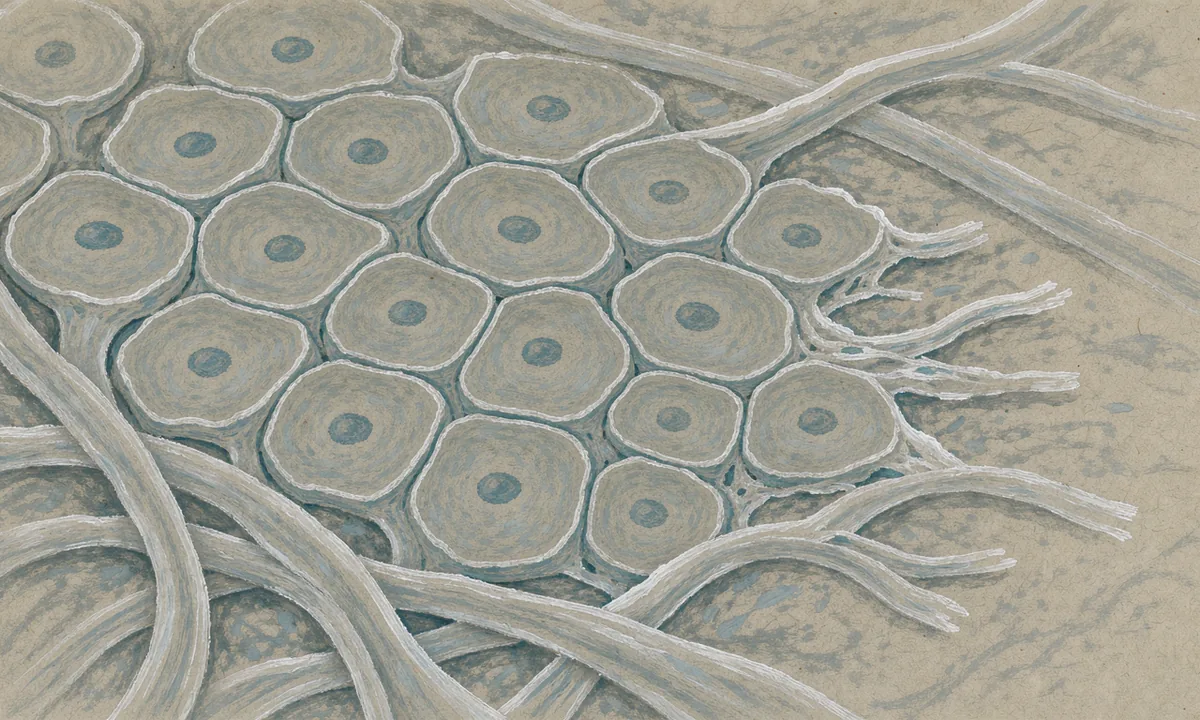
The illustration below concentrates on the surrounding matrix. It is a schematic view of remodeling, rather than an image from the experiment.
Thymosin beta-4 and actin
Inside a cell, actin provides material for a changing internal framework. The structural work on thymosin beta-4 and actin used an engineered hybrid bound to actin to resolve how the parent protein holds an actin monomer, a single unit, apart from a growing filament. It forms a 1:1 complex and caps both ends of the monomer.
The TB-500 peptide carries the LKKTETQ actin-binding motif of the parent protein. That explains the mechanistic interest in the fragment. The broader review of thymosin beta-4 connects actin binding with cell mobilization, migration and other repair-related activities. Evidence that a fragment carries a motif still leaves its whole behaviour in humans to be established.
I want the moving cell and its surroundings in the same picture; the enzyme and actin results give repair more substance than a general growth story.
Scarring and cell survival
The parent-protein review describes reduced myofibroblast number in repair research, relevant because those contractile cells contribute to scarring. It also describes effects on cell survival and inflammation. These are findings gathered across experimental systems, rather than a clinical scar-treatment result for TB-500.
In the mouse-heart and cell-culture work, thymosin beta-4 formed a complex with PINCH and integrin-linked kinase and activated Akt, a survival signal. Cardiac function improved after coronary artery ligation in mice. I count that mouse-heart outcome as a worthwhile finding. Human evidence for the short fragment would have to establish its effects separately.
Inflammation in laboratory models
The existing thymosin beta-4 literature includes suppression of inflammatory signaling in cell models. More recent animal and laboratory work on pro-resolving pathways links the parent protein to mechanisms involved in resolving inflammation.
Resolution has its own biology to explore. I would happily see more experiments follow that process through to a measured repair outcome. It gives the inflammation claim a more specific experimental direction. There is still no completed controlled human trial demonstrating an anti-inflammatory benefit from the TB-500 fragment.
TB-500 and BPC-157
TB-500 and BPC-157 are different peptides with different sequences and mechanisms. A comparison needs separate evidence for each. The sports-medicine review of unapproved peptides discusses both within a field where promising animal findings coexist with scarce rigorous human safety data and potential for serious harm.
Mechanism offers too shaky a basis for me to rank these peptides. A useful comparison would need clinical outcomes for the actual preparations being compared; a shared reputation for recovery supplies none of those measurements. The reported-effects page covers the kinds of accounts that circulate around TB-500.